

Vishalakshi Temple Varanasi : Have you ever felt a place pulse with divine feminine energy? In the ancient lanes of Varanasi, where spirituality flows as abundantly as the Ganges itself, stands the Vishalakshi Temple—a sacred shrine dedicated to Goddess Shakti that has drawn devotees for centuries. This isn’t just another temple in the city of temples; it’s one of the 51 Shakti Peethas, making it among the most powerful spiritual destinations in Hindu tradition.
Tucked away in the labyrinthine alleys near the famous Mir Ghat, the Vishalakshi Temple represents the cosmic feminine power that Hindus believe sustains the universe. The name “Vishalakshi” itself translates to “the wide-eyed one,” referring to the goddess’s all-seeing, compassionate gaze that watches over her devotees. When you step into this temple, you’re not just entering a building—you’re stepping into a story that connects heaven and earth, mythology and reality, ancient times and the present moment Vishalakshi Temple Varanasi.
The Divine Significance of Goddess Vishalakshi
Who is Goddess Vishalakshi?
Goddess Vishalakshi is a manifestation of Shakti, the primordial cosmic energy that powers creation itself. She represents the divine feminine principle that complements Lord Shiva, the divine masculine. In Hindu philosophy, Shakti is not merely a goddess—she is the active, dynamic force behind all existence, while Shiva represents pure consciousness.
Vishalakshi is considered an especially benevolent form of the goddess. Unlike some fierce forms of Shakti like Kali or Durga, Vishalakshi embodies maternal compassion and protection. Devotees believe she watches over Kashi (Varanasi) with her wide, loving eyes, blessing those who seek her grace with wisdom, prosperity, and spiritual liberation. Her presence in Varanasi adds to the city’s reputation as a moksha-kshetra, a place where one can attain liberation from the cycle of birth and death.
Connection to Shakti Peethas
The concept of Shakti Peethas is central to understanding the Vishalakshi Temple’s importance. According to Hindu tradition, there are 51 sacred sites across the Indian subcontinent where portions of Goddess Sati’s body fell when Lord Shiva carried her corpse in his cosmic dance of grief. Each site where a body part fell became a Shakti Peetha, a seat of divine feminine power.
Vishalakshi Temple marks the spot where Sati’s earrings fell—or according to some traditions, her eyes or ear ornaments. This makes it one of the most significant pilgrimage destinations for Shakti worshippers. The energy at a Shakti Peetha is believed to be extraordinarily potent, capable of granting wishes, healing ailments, and accelerating spiritual growth. For devotees, visiting all 51 Shakti Peethas is considered a supreme act of devotion, and Vishalakshi Temple in Varanasi is an essential stop on this sacred circuit.
Mythological Origins and Legends
The Story of Sati’s Self-Immolation
To truly appreciate the Vishalakshi Temple, you need to understand the heart-wrenching story behind all Shakti Peethas. The tale begins with Sati, the daughter of King Daksha, who fell deeply in love with Lord Shiva. Despite her father’s disapproval of the ascetic god, Sati married Shiva, defying royal expectations.
Years later, Daksha organized a grand yajna (fire sacrifice) and deliberately excluded Shiva from the guest list—a calculated insult. When Sati learned of this massive ceremony to which her husband wasn’t invited, she decided to attend despite Shiva’s advice against it. At the yajna, Daksha publicly humiliated Shiva with harsh words. Unable to bear the insults to her beloved husband, Sati invoked her yogic powers and immolated herself in the sacrificial fire.
Why Varanasi Became a Shakti Peetha
When Shiva learned of Sati’s death, his grief knew no bounds. In his anguish, he placed Sati’s body on his shoulders and began the Tandava—a cosmic dance of destruction that threatened to unravel creation itself. The universe trembled as Shiva’s sorrow manifested in catastrophic form.
To save existence from annihilation, Lord Vishnu intervened. Using his Sudarshana Chakra, he carefully dismembered Sati’s body so that the pieces would fall across the land, forcing Shiva to stop and eventually come to his senses. Where each piece fell, a Shakti Peetha emerged, forever marking that location as sacred ground infused with the goddess’s power.
The Sacred Eye That Fell
In Varanasi, at the location that would become the Vishalakshi Temple, tradition holds that Sati’s earrings or eye ornaments fell. Some texts suggest it was actually her left eye that descended upon this spot, which particularly explains the name “Vishalakshi”—the wide-eyed goddess. This connection to the eye is symbolically profound, as eyes represent perception, wisdom, and divine vision.
The spot where this sacred body part landed became supercharged with spiritual energy. Ancient sages recognized this power and established a shrine there, which has been maintained and worshipped continuously for millennia. The temple stands today as a living link to that mythological moment when divine sorrow transformed into sacred geography.
Location and How to Reach
Exact Location in Varanasi
Finding the Vishalakshi Temple requires navigating the wonderfully chaotic maze of Varanasi’s old city. The temple is situated in the Mir Ghat area, very close to the legendary Kashi Vishwanath Temple—in fact, it’s just about 200 meters away. The address places it on Ganga Mahal Road in the Vishwanath Gali area, though addresses in this ancient part of the city are more suggestions than precise coordinates.
The temple’s location is actually quite strategic. It sits in the heart of Varanasi’s most sacred zone, where religious energy seems to saturate every stone and alley. This area represents the spiritual epicenter of Hinduism, where countless temples, ashrams, and holy sites cluster together in a compact space that has witnessed unbroken devotion for thousands of years.
Nearby Landmarks and Ghats
Mir Ghat, the closest ghat to the temple, serves as an excellent reference point. This ghat is one of the older ghats along the Ganges and has its own historical significance. From Mir Ghat, the temple is just a short walk inland through the narrow lanes.
Another major landmark is, of course, the Kashi Vishwanath Temple itself—perhaps India’s most famous Shiva temple. The proximity of these two temples is spiritually significant, as Vishalakshi (Shakti) and Vishwanath (Shiva) represent the divine couple. Many pilgrims make it a point to visit both temples in sequence, honoring the cosmic balance of masculine and feminine divine principles.
Dashashwamedh Ghat, the most popular ghat in Varanasi known for its evening Ganga Aarti, is also within walking distance—about half a kilometer away. This makes it easy to combine a temple visit with the mesmerizing spectacle of the evening prayers by the river.
Best Routes for Visitors
Getting to Vishalakshi Temple depends on where you’re starting from, but here’s a practical approach: if you’re coming from outside the old city, the best strategy is to reach either Dashashwamedh Ghat or Godowlia Chowk by vehicle. From there, you’ll need to continue on foot through the narrow lanes, as most of the old city isn’t accessible by car or even auto-rickshaw.
Don’t hesitate to ask locals for directions—”Vishalakshi Mandir kahan hai?” will get you pointed in the right direction. Better yet, consider hiring a local guide who knows these lanes intimately. The winding alleys can be confusing for first-timers, and you might find yourself walking in circles. What looks like a straightforward 10-minute walk can easily become a 30-minute adventure if you’re navigating alone.
Early morning visits are ideal, as the lanes are less crowded and the spiritual atmosphere is at its most potent. The walk through these ancient alleys, with their centuries-old houses leaning toward each other and the scent of incense floating through the air, is itself a spiritual experience.
Temple Architecture and Structure
Architectural Style
The Vishalakshi Temple showcases traditional North Indian temple architecture, though it’s relatively modest compared to some of Varanasi’s grander temples. The structure has been renovated and rebuilt several times over the centuries, with the current form dating to more recent restoration efforts while maintaining ancient architectural principles.
The temple doesn’t overwhelm with size or ornate decoration; instead, it impresses with its spiritual authenticity and the palpable devotional energy within its walls. The entrance is marked by a simple doorway that opens into a small courtyard. The architecture reflects the practical constraints of building in Varanasi’s congested old city, where space is precious and structures must fit within the existing urban fabric that has accumulated over millennia.
The Sacred Sanctum
The inner sanctum, or garbhagriha, is where the main deity resides. This is a relatively small, intimate space that creates a sense of closeness with the divine. Unlike massive temple halls that can make you feel dwarfed, the Vishalakshi sanctum draws you into a personal encounter with the goddess.
The atmosphere inside is thick with devotion—the walls are darkened by centuries of oil lamp smoke, and the air carries the complex fragrance of incense, flowers, and camphor. The floor is smooth from countless devotees who have prostrated themselves before the goddess. There’s something deeply moving about being in a space that has absorbed so many prayers, tears, hopes, and expressions of gratitude.
The Deity’s Unique Form
The idol of Goddess Vishalakshi is striking in its simplicity and power. Unlike elaborately decorated temple images, the deity here is often represented by a sacred stone or a simple form adorned with traditional jewelry and garments. Her eyes—the defining feature—are depicted as wide and all-encompassing, radiating both compassion and cosmic awareness.
The goddess is typically shown with attributes that symbolize her protective and nurturing aspects. Fresh flowers, particularly red hibiscus which is sacred to Shakti, adorn the deity daily. During special occasions and festivals, the decoration becomes more elaborate, with expensive silks and ornate jewelry temporarily enhancing the goddess’s appearance.
Devotees believe that making eye contact with the deity’s eyes during darshan (sacred viewing) can be a transformative experience, as if the goddess truly sees into your soul and responds to your unspoken prayers.
Religious Importance and Spiritual Power
Why Devotees Visit Vishalakshi Temple
People come to Vishalakshi Temple for countless reasons, but certain themes emerge repeatedly. Many seek the goddess’s blessings for family welfare, protection from negative energies, and guidance in difficult life decisions. The maternal aspect of Vishalakshi makes her particularly approachable for devotees dealing with personal struggles.
Women, especially, feel a strong connection to this temple. They come seeking blessings for marital harmony, children’s wellbeing, and strength to navigate life’s challenges. The goddess’s association with eyes and vision also attracts devotees with vision problems or those seeking clarity in their life’s direction—both literal and metaphorical vision.
Spiritual seekers visit to tap into the Shakti Peetha’s powerful energy for meditation and inner transformation. The accumulated devotional energy of millennia creates an atmosphere conducive to deep spiritual experiences. Many report feeling an inexplicable peace wash over them the moment they step into the temple premises.
Blessings and Miracles Associated
Local tradition is rich with stories of the goddess’s interventions in devotees’ lives. While maintaining healthy skepticism, it’s impossible to ignore the consistent testimonials from believers who attribute life changes to Vishalakshi’s grace. People speak of diseases cured after praying at the temple, of impossible financial situations that resolved, of family conflicts that miraculously healed.
One commonly cited blessing is protection during travel. Many Varanasi residents make it a point to visit Vishalakshi Temple before embarking on journeys, believing the goddess’s watchful eyes will guard them. The temple’s priests share stories of devotees who returned to offer thanksgiving for safe returns from dangerous situations.
Whether you attribute these experiences to divine intervention, the power of faith, or psychological factors, the fact remains that this temple has been a source of hope and strength for countless individuals across centuries. The goddess’s reputation for responding to sincere prayers continues to draw new generations of devotees.
Connection with Lord Kashi Vishwanath
The relationship between Vishalakshi and Kashi Vishwanath temples represents one of Varanasi’s most profound spiritual truths. In Hindu cosmology, Shiva and Shakti are two aspects of the same ultimate reality—neither complete without the other. Shiva represents pure consciousness, while Shakti is the dynamic energy that manifests creation.
Many pilgrims ensure they visit both temples, recognizing that honoring one without the other is spiritually incomplete. Some traditions suggest that worship at Vishwanath Temple isn’t fully effective without also paying respects at Vishalakshi Temple. This interdependence reflects the balance between masculine and feminine principles that governs the universe.
During major festivals, priests from both temples sometimes coordinate rituals, acknowledging this sacred partnership. The proximity of the temples makes it easy for devotees to honor both the divine couple in a single pilgrimage, experiencing the completeness that comes from recognizing both aspects of divinity.
Festivals and Special Occasions
If there’s one time when Vishalakshi Temple truly comes alive, it’s during Navratri—the nine nights dedicated to the Divine Feminine. This festival, celebrated twice a year (spring and autumn), transforms the temple into a hub of devotional fervor. The goddess is elaborately decorated each day, with different forms and colors representing various aspects of Shakti.
The temple remains open for extended hours during Navratri, with special pujas (worship ceremonies) conducted throughout the day and night. Devotees fast, recite mantras, and perform kanya pujan (worship of young girls as embodiments of the goddess). The atmosphere becomes electric with bhajans (devotional songs), the fragrance of vast quantities of flowers, and the sight of thousands of oil lamps illuminating the darkness.
The ninth day, called Mahanavami, sees the most intense celebrations, with elaborate rituals and an especially powerful aarti that draws massive crowds. If you can only visit the temple once, timing your visit during Navratri will give you an unforgettable glimpse into the heights of Hindu devotional practice.
Diwali and Other Major Festivals
Diwali, the festival of lights, has special significance at Vishalakshi Temple. In some traditions, Diwali celebrates Lakshmi, but in Shakti-centric worship, it also honors the triumph of the goddess over darkness and ignorance. The temple is illuminated with countless diyas (oil lamps), creating a magical ambiance as flickering lights dance in the goddess’s eyes.
Other important occasions include Durga Puja, Mahashivaratri (when the connection with Vishwanath Temple becomes especially prominent), and various regional festivals specific to Varanasi. Each full moon night (Purnima) is considered auspicious for Shakti worship, attracting additional devotees.
Daily Rituals and Aarti
Even outside festival times, the temple maintains a regular schedule of rituals. The day begins with Mangala Aarti, an early morning ceremony that awakens the goddess. This is followed by Shringar (decoration), Bhoga (food offering), and multiple aartis throughout the day.
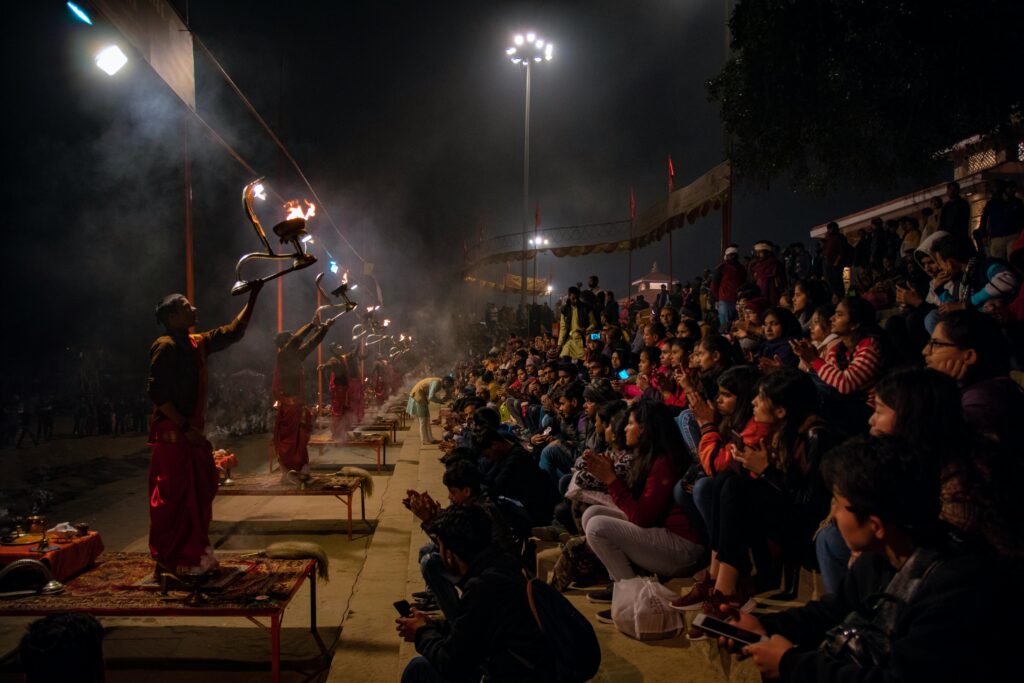
The evening aarti is particularly beautiful, as the lamp flames seem to multiply the goddess’s gaze, her wide eyes appearing to watch every devotee simultaneously. The rhythmic ringing of bells, the priest’s chanting, and the collective energy of gathered devotees create a sensory experience that transcends the ordinary.
Regular visitors often time their darshan to coincide with these aartis, as the energy during these moments feels particularly potent. The priests’ generations-old expertise in conducting these rituals ensures that ancient traditions continue unbroken into the present.
Visiting Guidelines and Temple Etiquette
Darshan Timings
The Vishalakshi Temple generally opens early in the morning around 5:00-5:30 AM and remains open until approximately 12:00 PM. It reopens in the evening around 4:00-4:30 PM and closes by 9:00-9:30 PM. These timings can vary slightly depending on the season and special occasions, so it’s wise to verify before planning your visit.
Morning visits offer several advantages: the lanes are less crowded, the spiritual atmosphere feels more concentrated, and you’ll avoid the afternoon heat if visiting during summer months. However, the evening aarti offers its own special ambiance that many devotees prefer. If possible, try to visit at different times to experience the temple’s varying moods.
During major festivals, the temple extends its hours significantly and may essentially remain open around the clock to accommodate the flood of devotees. Be prepared for longer wait times during these periods, but also for a more intense devotional atmosphere.
Dress Code and Conduct
Varanasi temples generally expect modest dress, and Vishalakshi is no exception. Men should wear shirts and full-length pants or traditional Indian attire like dhoti-kurta. Women should ensure their shoulders are covered and wear clothing that extends below the knees—traditional Indian dress like sarees or salwar kameez is always appropriate and appreciated.
Remove your shoes before entering the temple premises. There are usually designated areas for footwear, sometimes with attendants who will watch your shoes for a small fee. It’s advisable to wear easily removable footwear and perhaps carry socks, as the stone floors can get quite hot during the day or cold in winter.
Inside the temple, maintain a respectful demeanor. Speak softly, avoid touching the deity unless specifically instructed by the priest, and don’t push or crowd during darshan. Mobile phones should be silenced or turned off. If you wish to offer prayers, you can bring flowers (especially red hibiscus), coconuts, incense, or sweets, which can also be purchased from vendors near the temple entrance.
Photography Rules
Photography policies at Hindu temples can be strict, and many prohibit cameras and phones inside the sanctum. At Vishalakshi Temple, photography is generally not permitted in the inner areas where the deity resides. This policy protects the sanctity of worship and the privacy of devotees in prayer.
You may be able to photograph the exterior and courtyard areas, but always ask permission first. Some priests may allow photography in certain areas for a small donation to the temple. However, respect any refusal—these rules exist to maintain the temple’s spiritual atmosphere and prevent commercialization of sacred space.
The restriction on photography can actually be a blessing in disguise. Without the distraction of capturing images, you’re free to fully immerse yourself in the experience, creating memories imprinted on your consciousness rather than on a memory card.
Nearby Attractions and Temples
Kashi Vishwanath Temple
Just a couple of hundred meters away stands the legendary Kashi Vishwanath Temple, home to one of the twelve Jyotirlingas—the most sacred Shiva temples in Hinduism. The temple has a fascinating history spanning thousands of years, with multiple destructions and reconstructions throughout its existence.
The current structure’s golden spire, donated by Maharaja Ranjit Singh, is a landmark visible from various points in Varanasi. The temple complex has recently been expanded and beautified, with the controversial demolition of surrounding structures creating open space and direct viewing corridors to the temple from the Ganges ghats.
Visiting both Vishalakshi and Vishwanath temples in sequence is considered highly auspicious, representing the honoring of divine completeness—the union of Shiva and Shakti. Plan sufficient time for both, as Vishwanath typically has longer queues due to its immense popularity.
Mir Ghat
After your temple visit, Mir Ghat offers a peaceful spot to sit by the Ganges and reflect. This ghat is less touristy than Dashashwamedh, providing a more authentic glimpse of daily life along the river. You’ll see locals performing their morning rituals, doing laundry, or simply sitting in contemplation.
The ghat’s name comes from Mir Rustam Ali, an officer in the court of Nawab Asaf-ud-Daula, who constructed this ghat. The steps leading down to the river are weathered smooth by centuries of use, each stone a testament to countless pilgrims who have descended to touch the holy waters.
Other Sacred Spots
The area surrounding Vishalakshi Temple is dense with spiritual significance. Within walking distance, you’ll find the Annapurna Temple dedicated to the goddess of food and nourishment, the Kala Bhairav Temple where devotees worship a fierce form of Shiva, and numerous smaller shrines to various deities.
Each lane seems to hold another temple, another story, another invitation to deeper exploration. The Nepali Temple, with its distinctive pagoda-style architecture, offers a different aesthetic experience. The narrow Vishwanath Gali (lane) itself is lined with shops selling religious items, books, rudraksha beads, and other spiritual paraphernalia.
This concentration of sacred sites in such a compact area is unique to Varanasi. You could spend days exploring and still discover new shrines, each with its own devotees, legends, and particular spiritual atmosphere.
Personal Experiences and Devotee Testimonials
Walking through the lanes toward Vishalakshi Temple, I’ve encountered countless devotees whose faces reflect the diversity of India itself—villagers from rural Bihar, urban professionals from Mumbai, foreign spiritual seekers, elderly pilgrims completing what might be their final visit, and young mothers bringing their children to seek the goddess’s blessings.
One elderly woman I spoke with had been coming to the temple every Tuesday for forty years. She credited the goddess with protecting her family through numerous crises and saw each visit not as an obligation but as a joyful reunion with the divine mother. Her weathered hands moved expertly through the ritual gestures, her face radiant with devotion despite her age.
A young engineer from Bangalore described an experience of profound peace during his visit—a moment when his mind, usually racing with thoughts, suddenly became completely still as he gazed at the goddess’s eyes. He couldn’t explain it rationally but knew something significant had shifted within him.
These personal stories, repeated across generations and geographies, form the living tradition of the temple. They’re more compelling than any historical facts or architectural descriptions because they speak to the temple’s continuing power to touch human lives.
Tips for First-Time Visitors
Planning your first visit to Vishalakshi Temple? Here are some practical insights that can enhance your experience. First, start early—the lanes are cleaner, less crowded, and the morning energy feels particularly special. Dress modestly and comfortably, keeping in mind you’ll be walking through narrow lanes and possibly sitting on the temple floor.
Bring small bills for offerings, shoe-keeping fees, and potential donations. While donations are never mandatory, contributing to the temple’s maintenance is appreciated. Don’t carry too many valuables or large bags—temple spaces are compact, and managing belongings can distract from your spiritual experience.
If you’re interested in performing a special puja, consult with the temple priests. They can arrange various ceremonies suited to your needs and budget. Having a basic understanding of the ritual, even if you don’t speak the language, can make the experience more meaningful.
Most importantly, approach the temple with an open heart. You don’t need to be a Hindu or even a believer to appreciate the spiritual power of the place. Respectful curiosity and genuine openness to the experience are all you need to connect with the profound energy that permeates this ancient shrine.
Consider combining your temple visit with a boat ride on the Ganges at sunrise—the river view provides perspective on how the city’s sacred geography fits together. The temples, ghats, and river form an integrated spiritual landscape that has nourished souls for millennia.
Conclusion
The Vishalakshi Temple stands as more than an architectural structure or historical monument—it’s a living embodiment of the divine feminine, a portal connecting the mundane and the transcendent. In a world increasingly dominated by noise, speed, and distraction, this ancient shrine offers something profoundly counter-cultural: stillness, depth, and connection to something infinitely greater than ourselves.
Whether you approach it as a devout pilgrim, a cultural explorer, or a curious traveler, the temple has something to offer. It invites you to step outside your ordinary experience and touch, even briefly, the extraordinary dimension of existence that Hindus call Shakti—the creative power that animates all life.
As you navigate Varanasi’s chaotic, beautiful, overwhelming sensory landscape, let the Vishalakshi Temple be an anchor point, a reminder that beneath the surface chaos lies a profound spiritual order. The goddess’s wide eyes watch over this ancient city, and through her, the eternal feminine principle continues to nurture, protect, and transform all who seek her grace.
Your visit to this temple can be as simple as a brief darshan or as profound as a life-changing spiritual encounter—the goddess meets each devotee according to their readiness and need. In her compassionate gaze, you might just glimpse the truth that all the spiritual traditions point toward: that the divine is not distant but intimately present, not judgmental but unconditionally loving, not abstract but vividly, powerfully real.
FAQs
1. Can non-Hindus visit Vishalakshi Temple?
Yes, Vishalakshi Temple welcomes visitors of all faiths and backgrounds. Unlike some temples that restrict entry to Hindus only, this shrine is generally accessible to anyone who approaches with respect and genuine interest. However, you should follow all temple protocols regarding dress code, conduct, and photography. Non-Hindu visitors often report feeling the temple’s peaceful energy regardless of their religious affiliation, making it a meaningful cross-cultural spiritual experience.
2. What is the best time of year to visit the Vishalakshi Temple?
While the temple is open year-round, the ideal visiting period is October through March when Varanasi’s weather is pleasant. Within this window, visiting during Navratri (September-October or March-April) offers the most spectacular experience with elaborate decorations and special ceremonies. However, expect larger crowds during festivals. For a quieter, more contemplative visit, weekday mornings during non-festival periods are ideal, allowing you to experience the temple’s spiritual atmosphere without the rush.
3. Are there any specific offerings I should bring to the goddess?
Traditional offerings to Goddess Vishalakshi include red hibiscus flowers (her favorite), coconuts, incense sticks, red cloth, sindoor (vermillion), and sweets like ladoos or barfi. You can purchase these items from vendors near the temple entrance if you haven’t brought them. However, remember that the most important offering is your sincere devotion—the goddess values heartfelt prayer over expensive materials. A simple flower offered with genuine reverence is more meaningful than elaborate offerings made mechanically.
4. How much time should I allocate for visiting Vishalakshi Temple?
A basic darshan can take as little as 20-30 minutes if you arrive during non-crowded hours. However, to fully experience the temple’s atmosphere, absorb its spiritual energy, and perhaps witness an aarti ceremony, allocating 1-1.5 hours is advisable. If you plan to visit nearby temples like Kashi Vishwanath as well, set aside at least half a day. Remember that walking through the narrow lanes, potentially getting slightly lost, and stopping at small shrines along the way is part of the authentic Varanasi experience.
5. Is there an entry fee for Vishalakshi Temple?
No, there is no entry fee to visit Vishalakshi Temple. Like most Hindu temples, it operates on a donation-based system. You’re welcome to make a contribution in the donation box if you wish, but it’s entirely voluntary. If you want the priest to perform a special puja for you, there will be a dakshina (offering) for those services, with costs varying based on the complexity of the ritual. The shoe-keeping service outside may charge a nominal fee of 5-10 rupees, and guides offering to show you the way might expect a small tip.